




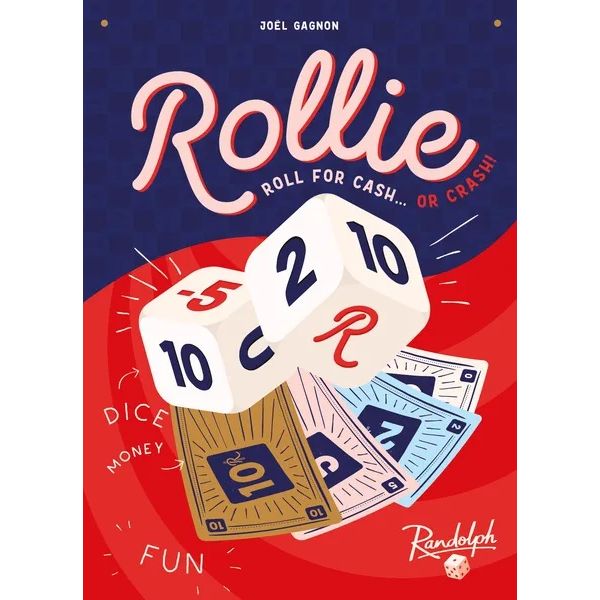
Roll the dice, claim bills, and try to stash ’em before you crash ’em!
Published by Randolph, Rollie is a push-your-luck dice game for 2-6 players, with a 20-minute play time.
On a player's turn, he is the first player. He rolls the two dice. If the two dice are different, each player at the table chooses to either take a bill or to secure. When taking a bill, a player takes one that matches the value of one of the dice (if a die rolled an R, that counts as a wild and he can take any bill). The bills have a value of -5, 0, 2, 5, and 10.
When a player takes a bill, he adds it to his stake pile. When a player decides to secure, he moves all the bills in his stake and adds them to his wallet. Bills in the wallet are safe for the rest of the game. The first player to secure each round also claims a tiebreaker token. After a player has secured, he cannot take more bills that round. If all players secured their stake, the round ends.
If the two dice roll the same number, everyone shouts "Rollie!" and the game pauses. Everyone checks the bills in their stash. If at least one bill matches the number rolled, all bills in the stash are returned to the supply. The round then ends.
The game ends after seven rounds or if two piles of bills are empty in the supply. Players earn bonus tokens for having the most, the second most, and the third most bills of each bill value, except for the 10s. In case of ties, the player with the highest value tiebreaker token wins the tie. Players add up their bonus tokens and their bills, and the player with the highest number wins the game.
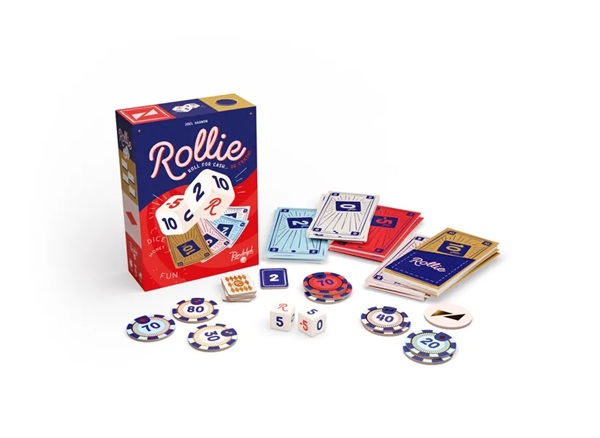
Rollie is a light, enjoyable push-your-luck game. It’s nicely put together with a great flow to the game. The choice is obvious: how long do you continue to grab bills, when there is a risk on every turn of losing all of them for the round?
The bonus chips are a clever mechanic, as well, as they lead to their own push-your-luck element with the -5s. Those chips are the most valuable, so it can be worth it to take a few negative points in order to claim one, but how far you go down that road can have quite an effect on your final score, especially if someone else manages to claim the chips over you.
With more players, the bonus chips work a little bit better, as the rules do not have you remove any based on player count, which is a little surprising. In a two-player game, it’s easy to ensure you’ll get at least one chip. You’re still battling it out for the top position, but it doesn’t feel quite the same as a four-player game, where someone can claim -5 bills and still walk away with nothing to show for it.
It is completely possible for a round to occur in which no one does anything, if doubles are rolled on the first turn. While it’s natural for push-your-luck games to have the chance of an early round end, it’s not satisfying when it happens here, as no one gets to do anything for that round at all. Everyone is crashing out. We chose to house rule this for our play session.
Paper money is always fun to play with, and the dice are a nice quality for rolling. Overall, this is an attractive little game, and quite portable. Rollie has one or two issues, but nothing that keeps the game from being thoroughly enjoyable.
Pros: Fun push-your-luck decisions, bonus tokens add a fun layer, nice components
Cons: No scaling for player count, possible to have a round that ends on the first roll
Disclosure: we received a complimentary review copy of this game.



The "Buy from Amazon.com" button above is an affiliate link. If you purchase using this link, we may earn a commission.